
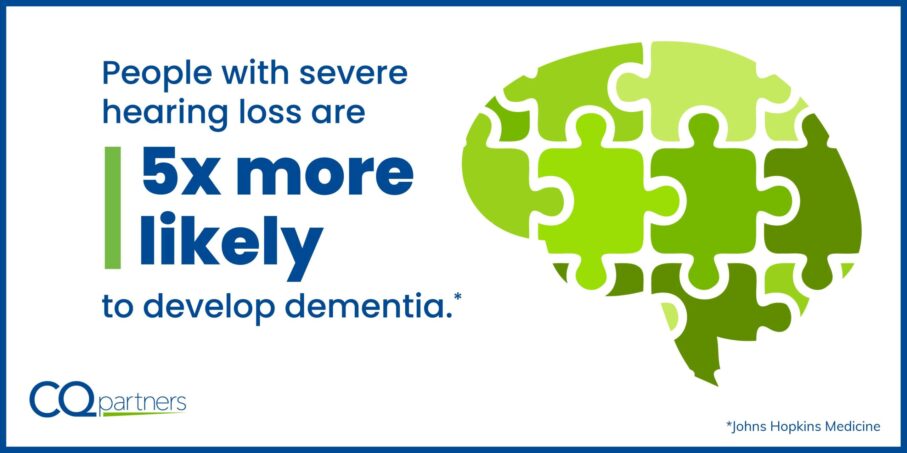
Individuals with hearing loss have a greater risk of cognitive decline and developing Alzheimer’s disease than those with normal hearing.
Studies have proven there is a link between hearing loss and dementia or Alzheimer’s disease. In fact, just mild hearing loss can double your dementia risk. Your risk increases with the severity of your hearing loss. Adults who have moderate-to-severe hearing loss have up to five times the increased risk of experiencing cognitive decline or dementia (Johns Hopkins Medicine, 2022).
While both hearing loss and dementia can seem frightening, knowing more about the connection between the two and what you can do can help you manage your risk.
What’s the connection?
Hearing involves more than just your ears – it involves your brain as well. You don’t hear sound when it enters your ears, you hear when sound waves travel through your ears up to the auditory cortex of the brain. In the brain is where the sound signal is processed into information and stored in your memory.
When hearing loss is left untreated, it can cause changes in the brain – such as shrinkage – that increase the risk for dementia or Alzheimer’s. Hearing loss makes it harder to hear sounds and to interact with other people. This can lead to feelings of embarrassment and even social isolation.
The key connection between hearing loss and dementia is due to brain overload. When you can’t hear well because of hearing loss, your brain has to work overtime to understand what people are saying. This puts excess strain on your brain just to hear throughout the day, leaving you feeling mentally fatigued. Because the brain is so fatigued from straining to hear all day, it doesn’t have the energy to perform other crucial tasks such as remembering, thinking, or acting.
If your brain has to work harder just to focus on sound, then it is not able to perform other basic cognitive functions that are necessary to keep healthy. Over time, this can worsen symptoms of cognitive decline, dementia, and even Alzheimer’s.
What can you do?
The best thing you can do to keep your brain active and healthy is to treat any signs of hearing loss early. If you are experiencing any trouble hearing or you feel mentally fatigued at the end of every day, then you should visit a hearing specialist.
Adults over the age of 60 should see a hearing specialist annually to ensure their hearing health is in check.
If you are experiencing hearing loss, there are resources available to help you. As the preferred provider network of hearing health education and solutions for the NFL Player’s Associations’ Professional Athletes Foundation (PAF), CQ Partners connects patients in need of hearing care with expert providers who can help them. The two organizations have partnered since 2011 to bring better hearing to former professional athletes across the nation. Call 866-304-1588 or visit our page to start hearing better today.